Just had my hair cut ahead of tonight’s three hour bum ache as I host my first live radio phone-in. After a long debate with the barber about my suggestion that an Obama cut would symbolise the beginning of a new age of broadcasting, I eventually went with the old faithful of part-lift/half flop with a curl over the left lughole. It’s not a good idea to change a winning formula and I want to be at my familiar best when I take up the reigns of the Richard Bacon show on 5Live at 10pm.
Only, to be perfectly honest, the whole thing has already gone nipples vertical, as it were. It happened the moment I walked into the BBC studios this morning thinking I was about to have a chat with Richard about his show and all the innovations I want to bring to medium of radio.
I was met in the foyer by some small puff of a PR assistant who led me to a small office where she left me in the care of a young chap. He was typical of BBC researchers, sitting behind a PC and spending most of his hours searching YouTube.
I took a seat, smiled politely at him, before looking at my watch. I had a dinner appointment with the Ant percentage of Ant&Dec and I didn’t like to be left waiting. I suppose I’m also use to being the bigger fish over at the Channel 4 pond and now in Watch’s modestly sized aquarium. But, in the BBC, you’re always reminded that there are always bigger fish and that the name Madeley counts for very little in a waters dominated by the likes of Wossy and Clarkson.
So, I waited and waited and the young chap on the keyboard kept clicking away as he downloaded more inane clips of animals doing party tricks. All pleasant, I suppose, if you enjoy waiting for things to happen in the company of imbeciles. Only I’m not that kind of man. It wasn’t long before I began to huff and mutter as I repeatedly looked at my watch. My message seemed to get across. After a few minutes, this young upstart fellow says ‘fancy a drink?’
‘I suppose I do,’ I replied, looking again at my watch. ‘Coffee. Four sugars...’
And off he went as I carried on waiting for Bacon and growing more annoyed with each passing minute. Five more minutes pass before the youth comes back carrying something hot and sweet in polystyrene.
‘We’re all out of sugar so I had to use sweetener,’ he said as I set my lips to sipping java.
‘Sweetener!’ I tutted but it wasn’t a soft, slightly annoyed tut. This was the sort of tut that would shatter poorer quality porcelain. Thankfully, all my crowns are cast from Tungsten and have been given a glaze of the same ceramic they use on the Space Shuttle’s heat shield. My tuts are as hard as bullets. Especially in cold weather.
‘What’s wrong?’ he asked.
There was something about the youngster’s attitude I didn’t like.
‘You know what sweetener does to a man’s procreative orbs, don’t you?’ I asked, fixing him with a leathery eye. ‘I don’t suppose you do. Well let me tell you...’
I then launched into a five minute tirade about sweetener addiction and the effects it can have on a man’s most potent juices. Just as I was coming to the end via a small digression on the inefficiency of assistants in show business, the PR girl came in again.
‘You okay, Richard?’ she asked.
‘Okay?’ I spat my indignation. ‘Not when this loaf gives me sweetener in my coffee. My manliness diminishes with every second the stuff is in my system.’
She seemed unconcerned and turned to the loaf in question. ‘Richard? Is everything okay?’
‘Fine,’ says the loaf from behind his desk. ‘Could you please call security?’
‘Richard?’ I repeated as the girl headed off.
‘Richard Bacon,’ he said as he stood up, his knuckles white as he gripped the back of his chair.
‘Oh,’ I replied. ‘Bacon!’
‘Just like the meat.’
‘I see,’ I said. ‘So you’re Richard Bacon...’
‘Like the...’
‘Just like the meat.’ I laughed. ‘So you’re more meat than loaf...’ He didn’t seem to appreciate my play on words so I thought it best to get on with making an apology. ‘I’ve made an awful fool of myself,’ I said. ‘When they told me I was filling in for Richard Bacon, I think I must have been thinking about Richard Baker. Now I come to think of it, he must be getting on a bit to be hosting three hour talk shows past midnight...’
‘Lucky that he isn’t,’ said Bacon, who grew a little easier and lowered the chair from over his head. He took my hand in his and gave it the traditional BBC shake with his little finger tickling my wrist.
‘Sorry about that,’ I said. ‘It’s just that you look too young to have your own show on 5Live.’
‘I’m actually forty three,’ he answered, ‘but please keep that quiet. I’ve not undergone years of treatment with the goat glands to ruin the illusion.’
‘Oh, I know how to keep a secret,’ I said. Which is true. Nobody reads this bloody blog so anything I write here is as safe as if I’d announced it on a weeknight on Watch. ‘All I can say is that I hope I look as good when I’m forty three.’
In the end, I had a good half hour minute chat with Bacon about tonight’s show. I promised that I’ll be gentle with his guests and I won’t plug my highly acclaimed book, ‘Fathers & Sons’, more than ten times an hour after midnight. We parted as friends, with him enthusiastic about all of my innovations.
‘But remember what I said about the goat glands,’ he said. ‘Don’t mention them to a soul.’
‘You just go and enjoy your holiday,’ I said. ‘Leave the worrying to me. If playing Westlife albums backwards and live ritualistic invocations to the spirit of Marconi don’t drive up your ratings, I don’t know what will.’
He laughed like any carefree forty three year old would laugh when going on holiday and leaving his successful national radio show in the hands of a professional with a new haircut and a quiff or two of sexiness.
Tuesday, 20 January 2009
Dick Bacon


Thursday, 20 December 2007
The Autobiography: BBC Radio Carlisle
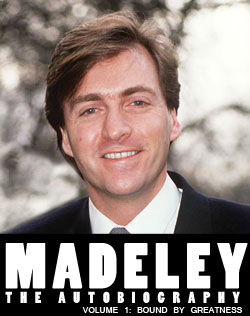 Both The Daily Mail and The Sunday Times have contacted my agent to see if they could be the first to print details from my forthcoming autobiography. Instead, I’ve decided that you, the dear disciples of my Appreciation Society, should have the first opportunity to read extracts from the book. Unfortunately, there were certain contractual obligations I was forced to accept along with my £500,000 advance and I only have permission to post a few chapters here. The rest of the book will have to remain a secret until it goes to press in the summer.
For the moment, I hope you'll enjoy chapter one, which opens at the beginning of my broadcasting career, when I was working at BBC Radio Carlisle.
In the beginning, there were knees.
There were two knees, to be precise, dressed in an airy fold of chequered trouser with full Donny Osmond flair, and they were both mine, rattling together at a good rate as I counted off the steps leading up to the newsroom at BBC Radio Carlisle. The peculiar garb surrounding the knees could be attributed to the wild days of 1975, their energy to the fact that this thin grub of a nineteen year old had just come back from recording the interview that would change his life.
How strange it is to describe my younger self. Six ripe feet of confidence, an inch or so of ambition, and the whole thing topped off with a twist of something special. Young Madeley was made in my image, or I made in his, and there was nothing that was going to stand in the way of our reaching the top.
My shoulder made light work of the newsroom doors as I barged into the studios that day. I marched towards my desk at the rear of the office, giving a mighty lung of ‘Hi guys!’ to the small enclave of reporters stuck there.
‘Ah, Madeley,’ said old Ben Primrose, the station’s chief newsreader, editor, and the man who taught me the golden rule that reporters always go that extra mile for a good scoop. He was sitting on his chair, feet on his desk, and a pencil prying that extra mile into the cavity of his right nostril. ‘I trust you’re sounding so bright because you’ve finally brought me the piece on the council’s grid replacement policy I asked for last week.’
‘I’ve got something better,’ I told him. ‘Prepare to see the future! The impish charm of Madeley has done it again!’
‘Done what?’
I brushed him aside and made my way to the desks beyond. One was my own; the other, that of Simon Drisdale, a behemoth of casualwear and skin conditions. He was related to Primrose in a way that I never did establish and was rapidly making a name for himself as a local crime reporter, first on the scene of every snatched bag and tampered parking meter.
‘I have in my possession a tape containing twenty minutes of quality gossip and chat.’ I turned to face the pair of them as I set my heavy tape recorder on my desk and let the strap fall from my shoulder.
‘Gossip?’ scoffed Drisdale. ‘And here I was thinking that you were out there working on a proper story.’
‘Gossip can be news too,’ I said, taking off my jacket and sitting down at my desk. The big tape deck had rubbed my shoulder raw but it had been worth it.
‘So who have you interviewed?’ asked Drisdale.
Officially, Primrose was the only person who could question me about my role in the news department. Not that this stopped his relative-of-undisclosed-significance from giving me the third degree when he felt like it.
I looked at him and felt a smile spread my upper cheeks. ‘On this tape I have an interview with the nation’s favourite funny man.’
‘Richard Briars!’ laughed Ben from the other desk. ‘I love The Good Life as much as the next person but it’s hardly news.’
‘It’s not Richard Briars,’ I replied.
‘Eric Morecambe?’ returned Drisdale. ‘Bob “Golden Shot” Monkhouse? The Honourable Nicholas Parsons of “Sale of the Century” fame? Or is it Ed “Stewpot” Stewart from “Crackerjack”?’
‘Crackerjack!’ cried Ben.
I was in no mood for antics. ‘I’m talking about Bill Oddie.’ I said at last.
‘The Goodie?’ snorted Ben. ‘Are they still going?’
‘Man, oh, man! Are they! This is 1975!’ I said, winding the spool to the beginning of the interview. ‘The Goodies are this decades Beatles, only they’ve promised us that they’ll never break up.’
‘Perhaps they should,’ said Ben. ‘Then you might have some news for me and a good reason why this radio station continues to ignore the large scale replacement of the county’s grids.’ He swung his legs from the desk and leaned forward, resting his elbows on his knees as he ran a hand across his well oiled comb-over. It was the hairstyle of choice for any true radio or TV journalist and I had found myself envying it on more than one occasion. ‘You really don’t understand what we’re doing here, do you Madeley?' he asked. 'People turn on their radios to hear news. They want to know about the world situation, what the Mr. Wilson has to say…’
‘And crime,’ added Drisdale. ‘People want to know that their handbags are safe and, if they’re not safe, they want us to assure them that The Sweeney are just around the corner.’
‘Exactly right, Simon. You see, Madeley, our audience expect us to be serious. They don’t turn on the radio to be entertained. They want news about grids. Not some squeaky voiced hippy telling us about a show he’s made for dim witted children.’
‘But the news of the future will be like this,’ I protested. ‘The news of the future will be full of celebrity gossip and journalists won’t have to go out and get stories. Stories will come to us. We won’t have to talk about grids. We’ll spend our days with interesting people, learning about their fascinating projects. We won’t need to go down to community centres and interview people about bring and buy sales. Journalists of tomorrow won't know how to spell "fête". We’ll be in state of the art studios, listening to Cilla Black tell a funny anecdote about Johnny Morris and a lemur.’
Ben picked his pencil again, only this time to use its moist end to gesture at me. ‘Cilla Black’s lemur might be the future, Madeley,’ he said, ‘but, while I’m in charge, you won’t be filling our airtime with any of that celebrity rubbish. You need to sort yourself out or you’ll never be a success here at BBC Radio Carlisle. If you aspire to sit in this seat, you’ll have to learn what it is that people want. Remember, it might not be as exciting as interviewing Bob Oddle, but there’s nothing wrong with an honest story about grids.’
History teaches us that the briefest of moments can radically change the future. This could well have been one of those times. I sat at my desk, fury cramping my hands on that tape machine. I looked up into Drisdale’s face and saw a look of elevated pleasure inflating his cheeks until they were taut, red, with a sheen of delight as though they were ready to burst.
Barely able to hold my anger back, I grabbed my jacket.
‘Where are you going?’ asked Ben.
‘I’ve left my notebook at Bob Oddle’s hotel room,’ I lied and stormed from the building. I thought I’d never go back.
That night, I lay alone in my room in the small bedsit on Viaduct Road and stared up at the cracked, water-stained plaster, much as I imagine Michelangelo occasionally took a gander at a ceiling and wondered how it would look with a few pert breasted nymphs. Only I saw visions of a different kind. I saw sofas and television sets dressed in creams and shades of pastel. I saw happy faces engaged in light hearted banter about a whole manner of interesting subject. I could see myself, sitting alone on that large sofa, talking to the world’s most celebrated people and occasionally cutting across what they were saying with a choice observation of my own. Just as I began to interview Dolly Parton and tell her about uses of mutton in the Restoration, a voice cut through it all and brought me back to Carlisile.
‘Richard? There’s somebody on the phone,’ shouted Mrs. Crumb, my landlady, from the bottom of the stairs. ‘He says his name’s Ben.’
I picked up the phone with a sullen grasp, all fingers and very little palm.
‘Hello?’ said a voice I knew at once wasn't that of Ben Primrose. ‘Is that young Madeley?’
I said that it was.
‘Bill Oddie here…’
My heart skipped not one beat but a few and certainly enough to kill a less healthy man. Poor old Mrs. Crumb. Through the persistent wax that plugs her ears, ‘Bill’ had become ‘Ben’. Instead of being told that I’d been relieved of my grid reporting duties at BBC Radio Carlisle, I was again speaking to the world’s greatest Goodie.
‘Are you the young chap who came and interviewed me today?’ asked Oddie. ‘Only, I was wondering if my interview had been broadcast yet.’
‘N… no, no it hasn’t,’ I stammered. ‘And to be honest, it might never get broadcast.’
‘Oh,’ said Bill. ‘Was it not good enough?’
‘It’s not that, at all. I’ve been told the interview doesn’t fit with the news policy of BBC Radio Carlisle.’
‘I see,’ said Oddie. ‘That’s a bit awkward isn’t it? Still, I suppose there’s no harm done. You can always boast that I’m the Goodie that got away.’
‘That’s not the point,’ I said, my passion overwhelming me. ‘They should play your interview. I know there are lots of people out there who want to hear about your life as a Goodie. They want to know if Graham’s sideburns are really his own? Does Tim really wear union jacket underpants? Do you all sleep in the same bed and, if so, who lies in the middle?’
‘Oh, it will all have to wait for another time,’ replied Bill. ‘Don’t be too down about it. It’s not that important. It’s just an interview…’
‘But it isn’t just an interview,’ I said, scolding the man. ‘Can’t you see that’s the problem? This is about the future.’ Somewhere, my appeals had turned into sobs and my face felt the heavy grease of the deepest tears. ‘Why do interviews have to be dull? Why should the interviewer not ask the questions that everybody wants answered? And why can’t I occasionally chip in with a word or two of my own? Were you offended just because I stopped the interview to explain my theory on how termites reproduce?’
‘No…’
‘Of course you weren’t!’ I replied. ‘If anything, it turned an average interview into something that would enhanced our mutual reputations. And don’t you see that this is the future? Didn’t people tell the young Henry Ford that he was mad when he fitted a petrol engine to an ironing board? But didn’t he show them?’
Oddie seemed startled. His voice rose an octave. ‘Oh, I didn’t know that he did… An ironing board? Fancy that.'
‘The first petrol power ironing board,’ I corrected.
‘Yes,’ said Bill. ‘But regarding my interview, I’m sure you’ll take them around if you tell them how you feel about it.’
‘They might do, except I’ve decided to quit,’ I explained, as much to myself as to Oddie. I’d worked so hard to get a break in journalism that, until this point, I hadn’t been able to acknowledge how far this setback had taken me. My voice was strangled by emotion. ‘The truth is, Mr. Oddie,’ I gasped, ‘I’m beginning to think that the news business isn’t for me…’
I didn’t wait for a reply. So overwhelmed by disappointment, I simply thanked him for ringing me and I hung up the phone. Soon I was back in my room. I dropped onto the bed and fell into a deep sleep, my own tears replaced by those of a specially invited audience of viewers laughing at my interview with Bob Hope.
The noise of feet storming the stairs woke me, perhaps an hour later. Then the door rattled.
I rolled out of my cot, surprised to find myself still wearing my office clothes.
Light blistered my eyeballs the moment I opened the door.
They were colours like I’ve never known, cast into shapes, psychodelic and mysterious, where the wild orient mated with abstract geometry with a hint of the Hawaiian. A shirt the colour of a molten sky was being assaulted by a gold medallion, handing over a pair of bright yellow dungarees. The whole ensemble was overgrown by coarse black hair, spouting from every opening yet the whole of this burning mess reached no higher than my elbows.
Standing on the doorstep was a bundle of fundamental elements, in a hot state of comic fusion.
‘Grab your coat and come with me,’ said the nation’s favourite Goodie. ‘There’s something I want you to see.’